
FR3 Spectrum and the Development of 6G Antenna Technology
-
admin
- 29th September 2026
The development of 6G wireless communication is bringing new attention to radio spectrum, antenna design and RF system technology. While 5G networks continue to expand around the world, researchers and wireless technology companies are already working on the technologies that may support the next generation of mobile communication.
One of the most discussed areas in current 6G research is Frequency Range 3, commonly known as FR3. In the current 3GPP terminology, FR3 generally refers to the upper mid-band between approximately 7.125 GHz and 24.25 GHz. It sits between FR1, which covers lower-frequency cellular spectrum, and FR2, which includes higher-frequency millimeter-wave bands.
FR3 has attracted attention because it may provide a useful balance between bandwidth and radio propagation. Lower-frequency bands can provide wider coverage but have limited available bandwidth, while higher-frequency bands can offer large bandwidth but experience greater propagation loss. FR3 is being studied as a possible middle layer for future 6G networks.
For the antenna industry, this development is important because moving wireless systems into new frequency ranges also requires new antenna structures, arrays, RF components and testing methods.
What Is FR3?
FR3 is often described as the upper mid-band for future wireless communication.
The 7.125–24.25 GHz range is positioned above conventional sub-7 GHz cellular bands and below the current FR2 range. Research published in 2026 describes FR3 as a promising candidate for 6G because it can offer more available spectrum than traditional mid-band frequencies while avoiding some of the severe propagation challenges associated with much higher millimeter-wave frequencies.
This does not mean that the entire FR3 range will automatically become a global 6G operating band. Spectrum allocation depends on national regulations, international coordination and the protection of existing services.
Several parts of the spectrum are already used by other systems, including satellite communications, radio astronomy, radiolocation and earth observation services. Future 6G networks will therefore need to coexist with existing users of the spectrum.
This is one of the reasons why FR3 research is not only about higher frequencies. Researchers also need to understand propagation, interference, antenna radiation patterns and the practical conditions of deploying networks in these bands.
Why FR3 Is Important for 6G
The main attraction of FR3 is the potential combination of capacity and coverage.
Wireless traffic continues to increase as more devices become connected. Future networks are expected to support mobile broadband, industrial communication, connected vehicles, IoT devices, sensing applications and other services at the same time.
FR3 could provide additional spectrum for these applications.
Compared with lower-frequency bands, FR3 can offer wider channels and greater bandwidth potential. At the same time, frequencies in this range generally have less severe propagation loss than much higher millimeter-wave bands.
A 2026 study comparing FR1, FR3 and FR2 found that FR3 can provide an attractive balance between coverage and capacity. The researchers also examined different urban environments and antenna array configurations to better understand the propagation characteristics of FR3 systems.
For network planners, this balance could make FR3 useful for future high-capacity networks in urban, suburban and enterprise environments.
For antenna manufacturers, however, the move to FR3 introduces several new design requirements.
New Requirements for FR3 Antennas
An antenna designed for FR3 cannot simply be treated as a higher-frequency version of an existing cellular antenna.
At higher frequencies, antenna dimensions become smaller relative to wavelength. This can make it possible to integrate more antenna elements into a limited physical area, but it also increases the importance of manufacturing accuracy and antenna layout.
A small change in antenna dimensions can affect the operating frequency and overall RF performance.
The antenna also needs to work with the RF front end and other components of the wireless system. Connector selection, transmission lines, PCB materials, antenna spacing and enclosure design all become part of the engineering process.
For future 6G equipment, antenna design will therefore be closely connected with the mechanical and electrical design of the complete device.
Wideband Antenna Design
One of the main areas of FR3 antenna research is wideband operation.
Future wireless systems may need to support several portions of the FR3 spectrum rather than relying on one narrow frequency band. This creates a demand for antennas capable of maintaining suitable performance over a wider range.
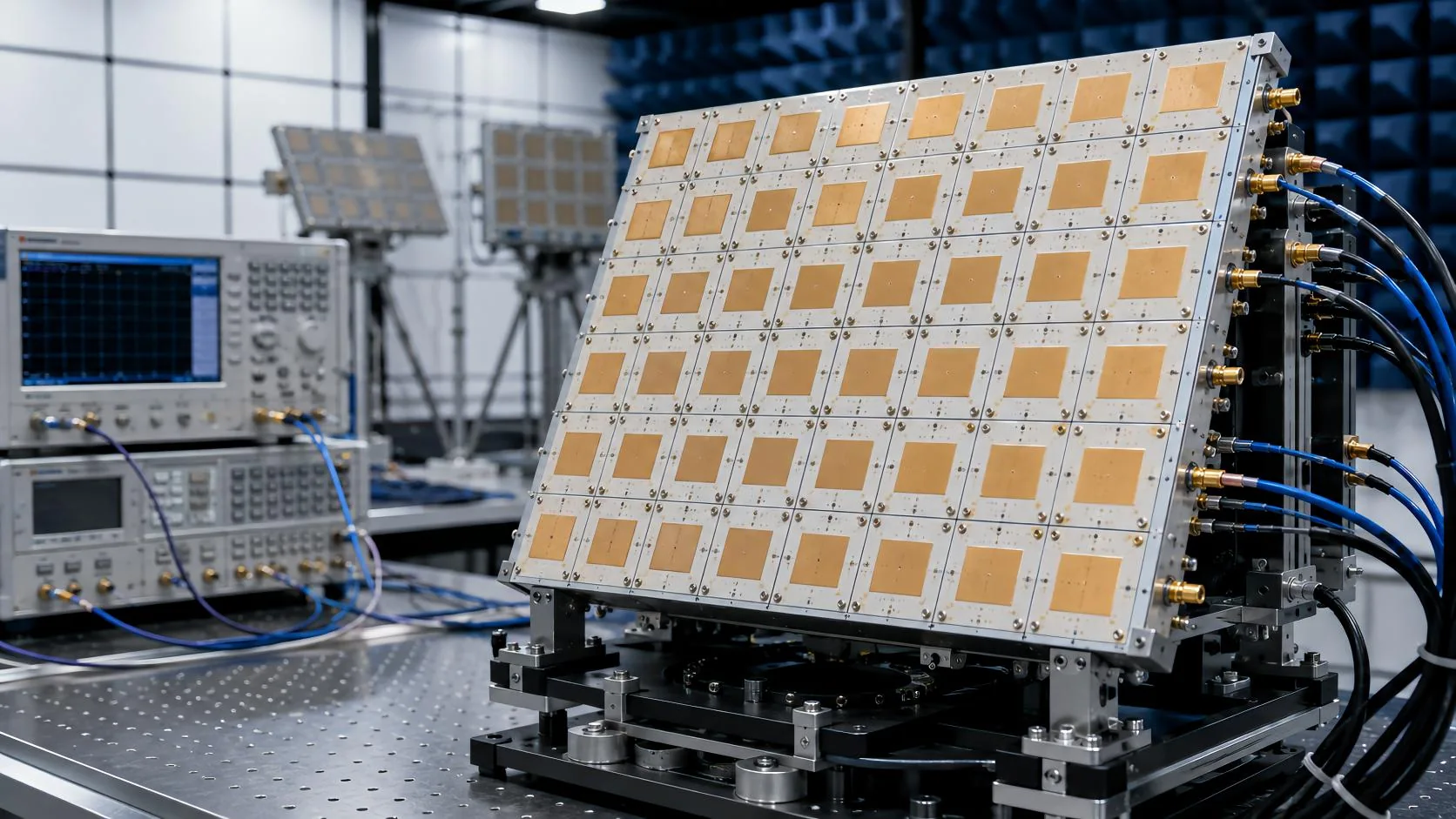
A research paper presented at the 2026 IEEE MTT-S Radio Frequency Systems and Applications Symposium described a wideband dual-polarized 4×4 antenna array designed for 7–24 GHz FR3 operation. The reported design was developed for MIMO applications and integrated with beamforming integrated circuits.
This type of work shows the direction of current research: instead of designing a simple single-band antenna, engineers are looking at wider bandwidth, multiple antenna elements, dual polarization and beamforming as part of the same RF system.
Wideband antenna design is technically challenging because maintaining good impedance matching, gain, radiation efficiency and radiation patterns across a large frequency range is not easy.
MIMO and Large Antenna Arrays
MIMO will remain an important part of future wireless communication.
FR3 offers enough bandwidth to support high-capacity communication, but achieving high performance may require antenna arrays with multiple elements.
Multiple antenna elements allow a wireless system to use spatial information more effectively. Through beamforming and other signal-processing techniques, the system can direct radio energy toward a particular user or area.
This can help improve coverage and system capacity.
However, adding more antenna elements also increases the complexity of the antenna system.
The spacing between antenna elements, mutual coupling, polarization, feed networks and RF losses all need to be considered. When antennas are placed close together, the electromagnetic interaction between elements can affect their performance.
For this reason, FR3 antenna development is closely connected with MIMO antenna research.
A recent 2026 study on a FR3 MIMO antenna array also examined ways to improve isolation and reduce mutual coupling between antenna elements, showing the practical challenges involved in building dense antenna arrays for 6G systems.
Beamforming and Directional Control
Beamforming is another important technology related to FR3.
Instead of transmitting RF energy equally in all directions, a multi-element antenna array can adjust the phase and amplitude of individual antenna elements to form a directional beam.
This allows a wireless system to make better use of the available RF energy.
At FR3 frequencies, beamforming can become especially useful because antenna arrays can be physically smaller than equivalent arrays at lower frequencies.
This creates opportunities for integrating more antenna elements into communication equipment without requiring extremely large structures.
At the same time, beamforming requires accurate antenna elements and RF channels. Small differences between antenna elements can affect the overall beam pattern.
The antenna manufacturing process therefore becomes increasingly important.
Antenna Manufacturing Accuracy
The development of higher-frequency antenna systems also places greater emphasis on manufacturing consistency.
For conventional RF antennas, manufacturers already need to control dimensions, connector installation, cable assembly and material selection. FR3 antenna arrays can introduce additional requirements because the physical dimensions of individual elements can be relatively small.
Manufacturing tolerances may affect the electrical performance of the antenna.
This means that future antenna production may require closer cooperation between antenna engineers, PCB manufacturers, mechanical engineers and RF testing teams.
Simulation can be used during the design stage, but physical prototypes still need to be produced and tested.
A production sample can then be evaluated against the original design requirements.
RF Testing for FR3 Antennas
RF testing is an important part of developing and manufacturing any new antenna technology.
For FR3 antennas, testing may include frequency response, impedance matching, VSWR, gain, radiation patterns, polarization and other RF characteristics.
Testing equipment also needs to support the relevant frequency range.
This is already becoming visible in the wireless testing industry. In February 2026, Anritsu announced hardware options for its MT8000A platform to support the FR3 frequency range, including lower-FR3 testing up to 16 GHz. The company noted that FR3 requires dedicated RF testing because its RF characteristics differ from conventional FR1 and FR2 systems.
At Mobile World Congress 2026, Anritsu and Qualcomm also demonstrated 7 GHz device-validation capabilities, highlighting the increasing industry interest in upper-mid-band technologies.
These developments show that the move toward FR3 is affecting not only antenna design but also the measurement and validation equipment used during product development.
FR3 and Integrated Sensing and Communication
Another interesting area is Integrated Sensing and Communication, often shortened to ISAC.
Traditional wireless networks are mainly designed to transmit information. Future systems may also use radio signals to detect objects, estimate movement, measure distance or understand the surrounding environment.
FR3 is attracting attention for this type of application because multiple frequency bands can potentially be used together for sensing.
A study published in npj Wireless Technology in July 2026 examined multiband sensing in FR3 and described how combining information from multiple frequency bands could improve sensing resolution. The research specifically investigated non-contiguous FR3 bands and coherent multiband sensing.
This suggests that future antennas may not only be designed for communication performance. They may also need to support sensing functions.
That could create new requirements for antenna bandwidth, array configuration and radiation control.
Miniaturization and Integration
Although FR3 frequencies are higher than traditional cellular bands, miniaturizing the complete antenna system is not necessarily simple.
The antenna itself may become physically smaller, but future 6G equipment may require more antenna elements, more RF channels and additional processing hardware.
The overall module can therefore still become complex.
A 2026 review of FR3 antenna research examined compact broadband and high-gain microstrip patch antennas for 6G applications. The review also discussed the use of machine learning for antenna optimization and highlighted the challenges of achieving wide bandwidth and high gain while maintaining a compact structure.
This is an important direction for the industry. Future antennas will need to balance several requirements at once rather than optimizing only one parameter.
The Role of Materials in FR3 Antenna Development
Materials also become important as frequency increases.
PCB materials, dielectric properties, surface finish, transmission lines and mechanical structures can all affect RF performance.
At lower frequencies, some material differences may have a relatively small effect. At higher frequencies, however, electromagnetic losses and material characteristics become more significant.
For mass production, the challenge is not only finding a material with suitable RF properties. The material also needs to be stable, available and suitable for manufacturing.
This is where antenna engineering and manufacturing experience need to work together.
FR3 Is Still a Developing Technology
It is important to recognize that FR3 is still under development.
The exact frequency bands used by future 6G networks will depend on international spectrum coordination, regulatory decisions and future 3GPP specifications.
The 2027 World Radiocommunication Conference is expected to be an important part of the discussion around future IMT spectrum. Samsung Research has highlighted several candidate upper-mid-band ranges and noted that the 12.7–13.25 GHz range is also being considered in the United States.
Therefore, FR3 should currently be viewed as an important area of 6G research and development rather than a finalized global commercial band.
For antenna companies, this stage is useful for testing new designs, studying propagation characteristics and developing manufacturing methods before large-scale commercial deployment begins.
What FR3 Could Mean for the Antenna Industry
The development of FR3 is likely to create demand for several types of RF technology.
These may include wideband antenna arrays, MIMO antennas, dual-polarized antennas, beamforming antenna modules, compact PCB antennas and specialized RF interconnects.
The industry may also see greater demand for customized antenna development.
Different devices will have different physical constraints, frequency requirements and antenna configurations. A standard antenna may not always be suitable for a specific 6G prototype or RF module.
For antenna manufacturers, this creates opportunities to support customers during both product development and mass production.
Engineering support, prototype production, RF testing and manufacturing consistency will become increasingly important as antenna systems become more integrated.
Looking Ahead
FR3 is one of the more closely watched spectrum areas in current 6G research.
Its position between lower-frequency cellular bands and higher-frequency millimeter-wave spectrum makes it interesting for future wireless networks that need both capacity and coverage.
The development of FR3 is also creating new challenges for antenna engineers. Wideband operation, MIMO, beamforming, compact integration, mutual coupling, material selection and RF testing all need to be considered when developing future antenna systems.
Research and industry activity in 2026 shows that these technologies are already moving beyond theoretical discussion. New antenna arrays are being demonstrated, RF test platforms are being extended into FR3, and researchers are studying real-world propagation and sensing applications.
Commercial 6G networks are still some years away, but the antenna technology needed for them is being developed now.
For RF antenna manufacturers, this makes FR3 an area worth following closely. The experience gained through current research, prototype development, RF testing and manufacturing will help shape the antenna products and wireless equipment of the next generation.